
AI SHIFT PREDICTIONS
Designed an AI-powered shift prediction tool to solve a costly operational problem: facility administrators were spending up to half their time in the app posting and canceling shifts. Led end-to-end from discovery and requirements through design, testing, and handoff.
THE CHALLENGE
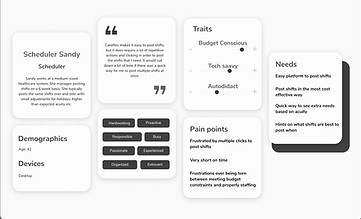
We discovered that users were spending between 25% and 50% of their time in the app simply posting shifts and another 25% to 50% canceling them. The process required multiple clicks and repetitive steps, creating unnecessary friction and frustration for facility operators.
Many users were overposting shifts to avoid being understaffed, then canceling the extras at the last minute. This not only created inefficiencies but also caused frustration for healthcare workers who had accepted those shifts. The behavior pointed to deeper workflow issues rather than just a lack of discipline or organization.
ROLE & SCOPE
Served as the lead designer, responsible for shaping the user experience of predictive tools. Defined user requirements based on research, translated requirements into clear visual formats, structuring workflows that connected prediction with action, and aligned design priorities with product goals. Collaborated closely with data scientists, product leadership, and engineering throughout the process.

RESEARCH & INSIGHTS
Research included behavioral analysis of in-app usage data alongside direct interviews with facility administrators to understand how staffing decisions were actually being made day to day. The data revealed the overposting and last-minute cancellation pattern described above, which reframed the problem from a UI issue to a workflow and prediction problem. Two consistent user needs shaped the design direction:
• Predictive insights had to be directly tied to familiar operational metrics
• Users needed transparency into prediction confidence and model reasoning
From this research, I developed design criteria that balanced advanced predictions with clarity, control, and trust.

STRATEGY & DESIGN DECISIONS
Key decisions on this project included:
• Integrating prediction outputs into existing operational dashboards so they felt like a natural extension of current workflows
• Designing visual forecast elements that balance clarity with depth, enabling users to explore probable scenarios without cognitive overload
• Including confidence levels and contextual cues so users could trust the AI suggestions
• Mapping clear next steps from prediction to scheduling actions so insights drove real operational outcomes
These strategies ensured predictions were not just visible, but usable and trustworthy.



OUTCOME & IMPACT
The shipped feature saved hundreds of hours of manual scheduling work by giving facility administrators accurate, confidence-rated predictions they could act on directly from their existing workflow. Delivered via detailed Figma specs, component documentation, and dev mode annotations, the handoff kept design fidelity intact through implementation.
The tool enabled users to:
Anticipate staffing needs accurately without overposting as a buffer
Move from prediction to scheduling action without leaving the platform
Trust AI-generated forecasts through transparent confidence indicators and contextual explanations
Make data-informed staffing decisions without needing statistical expertise
